Most Australian not-for-profits build their website the same way: a volunteer with some spare time, a budget of roughly nothing, and a committee that wants it live by the next AGM.
That constraint is fine. A community sports club, a neighbourhood house and a registered charity all need the same handful of things, and none of them are expensive. What sinks these projects is usually the order they get done in, and one Australian rule that catches almost everyone out at the domain stage.
Step 1: Decide what the website has to do
A non-profit website that tries to do everything converts on nothing. Pick one primary action, then design the homepage around it.
| Your main goal | Primary action | What the homepage must show |
| Fundraising | Donate | A donation button above the fold, plus what a specific amount buys |
| Recruiting volunteers | Sign up | Roles, time commitment and a short form |
| Membership or club sign-ups | Join | Fees, benefits and a season or intake date |
| Awareness and advocacy | Read or share | One clear story and easy social sharing |
| Service delivery | Get help | Contact details, opening hours and eligibility |
Write your choice down before anyone opens a design tool. Every later decision, from the navigation to the colour of one button, gets easier once the committee agrees on the answer.
Step 2: Choose a domain you are eligible to hold
This is the step that trips up Australian organisations, and it is the reason to sort your domain before you build anything.
.org.au and .asn.au are restricted namespaces. auDA requires proof that you are a not-for-profit entity, and since April 2021 an unincorporated association cannot hold a .org.au name unless it appears on the ACNC Register of Charities. Unincorporated groups can generally use .asn.au instead.
| Namespace | Who can register | Typical proof |
| .org.au | Incorporated associations, companies limited by guarantee, ACNC-registered charities, non-distributing co-operatives, Indigenous corporations | Active ABN or ACN with a not-for-profit entity type, or incorporated association number |
| .asn.au | The above, plus clubs, unions, political parties and other non-commercial groups | ABN or ACN, or incorporated association number |
| .com.au / .net.au | Australian commercial entities, including NFPs with a trading arm | Active ABN or ACN |
| .au | Any registrant with an Australian presence | ABN, ACN or Australian citizenship or residency |
Your name also has to connect to your organisation: your legal name, your business name, an acronym, or a program or event you run. For example “Bayside Junior Football Club” can register baysidejfc.org.au. It cannot register communitysport.org.au.
Two practical tips. Check your ABN is active on the Australian Business Register before you apply, because a lapsed ABN is the most common reason a registration or renewal fails. And register the matching .au and .com.au if they are available, so nobody else picks up traffic meant for you. Our Domain Names 101 guide covers how the namespaces fit together.
Step 3: Pick a platform your volunteers can actually run
The right platform is the one that still works when the volunteer who built it moves interstate.
| Option | Best for | Watch out for |
| WordPress (self-hosted) | Most NFPs. Free software, huge plugin range, easy to hand over to a new volunteer or any Australian developer | Needs someone to apply updates and backups, or a managed plan that does it for you |
| All-in-one fundraising platforms | Campaign-led charities that want donation forms and website in one place | Your site lives inside their product. Moving later usually means rebuilding |
| Website builders | Very small groups with one or two pages | Monthly fees add up, and export options are limited |
| Custom design | Organisations with a real budget and specific requirements | Cost, and ongoing dependency on the agency that built it |
For most Australian NFPs, WordPress on your own hosting is the safest choice. You own the site, the content and the domain, and you can move providers without starting again. If nobody on the committee wants to touch it, WordPress maintenance and support covers updates, backups and security for you.
Step 4: Get hosting that fits a not-for-profit budget
Hosting is where the website lives. Two things matter for a community organisation: an Australian server, so pages load quickly for Australian visitors, and support you can actually reach when the site goes down the week before your fundraiser.
Domain Central runs a Community Hosting Program for exactly this situation. Eligible Australian not-for-profits get free hosting on Australian hardware with a one-click WordPress installer, or a cPanel plan at $60 a year if your site is already on cPanel elsewhere. In return we ask you to display a Domain Central banner on your homepage. Existing sites can be migrated across at no charge.
To apply you need to be registered in Australia as a not-for-profit and be able to show it: ABN confirmation with NFP tax concession status, an ACNC charity registration number, or a certificate of incorporation. If you are still working through incorporation, talk to us anyway, since we can often get the hosting started while that is in progress.
Not sure what hosting actually includes? Web Hosting 101 explains it in plain English.
Step 5: Build the pages every non-profit website needs
Five pages will carry almost all of your traffic. Build these properly before you add anything else.
| Page | Its job | Include |
| Home | Explain who you are in five seconds and point to one action | Mission in a single sentence, hero image, primary CTA, proof such as the ACNC Registered Charity Tick |
| About | Build trust | Your story, committee or staff names and photos, ABN, incorporation details |
| Donate or Join | Convert | Suggested amounts with real impact, one-off and recurring options, secure payment |
| Programs or Services | Show the work | Who you help, where, and how to access it |
| Contact | Remove friction | Email at your own domain, phone, address, hours, map |
Add impact stories as you go. A short piece about one person you helped, with a real photo, does more for donations than a page of statistics. Keep the images your own where you can, because stock photography reads as generic to donors.
Step 6: Make giving easy and obviously safe
Donors abandon forms that feel risky or slow. Three fixes cover most of it.
Show trust signals near the donate button: the ACNC Registered Charity Tick if you are on the charity register, your ABN, and whether donations are tax deductible. Only ATO-endorsed deductible gift recipients can claim that, so check your DGR status before you write it on the page.
Keep the form short. Name, email, amount, payment. Every extra field costs you donations.
Offer a recurring option. Regular giving is worth far more over a year than a single gift, and the only reason many supporters do not choose it is that nobody asked.
Step 7: Use email at your own domain
An organisation asking for money from a Gmail address has a credibility problem. Once you own a domain, put your email on it. For example: treasurer@yourclub.org.au rather than yourclubtreasurer1998@gmail.com.
It also solves the handover problem. When the secretary changes, you reassign the mailbox instead of chasing someone for a password. Titan Mail gives each committee member a mailbox at your domain with calendars and contacts included, and it works on phones out of the box. See Email Hosting 101 for how it compares to a free account, and set up an SPF record so your newsletters reach the inbox instead of the spam folder.
Step 8: Cover security, accessibility and privacy
An SSL certificate is not optional. Without HTTPS, browsers warn visitors away from your site, which is fatal on a donation page. Most hosting plans include one. SSL Certificates 101 explains the types.
Accessibility matters more for NFPs than for most sectors, because your audience often includes people with disability. Follow WCAG basics: alt text on images, captions on video, headings in order, and enough colour contrast to read the text in sunlight. It is also good SEO, since the same structure helps search engines and AI assistants understand your pages.
If you collect donor or member data, say what you do with it in a privacy policy, and keep the site updated. Out-of-date WordPress plugins are the most common way small organisations get hacked.
Step 9: Help people find you
Give every page a clear title that matches what people search for. “Youth mental health support in Geelong” works. “Our Services” does not.
Write real answers to real questions in plain language, since that is what both Google and AI assistants pull from. Claim your Google Business Profile if you have a physical location, list your organisation on the ACNC register with a working website link, and ask partner organisations to link to you. Local links from councils, schools and community groups are some of the strongest signals a small Australian site can get.
Frequently asked questions
How much does a non-profit website cost in Australia? A domain is usually the only unavoidable cost, and hosting can be free through a community program. WordPress itself is free. Budget for a designer only if you want a custom look.
Can any club register a .org.au domain? No. You need to be a not-for-profit entity under the auDA rules. Unincorporated associations that are not on the ACNC register should look at .asn.au instead.
Do we need to be registered with the ACNC? Not to have a website. You do need ACNC registration to display the Registered Charity Tick, and DGR endorsement from the ATO before you can tell donors their gift is tax deductible.
How long does it take to build? A five-page WordPress site is a weekend of work once the content is written. Writing the content is what takes most groups several weeks, so start there.
Who should own the domain and hosting account? The organisation, not a volunteer. Register everything in the organisation’s name with a shared committee email address, so access survives a change of committee.
Get your organisation online
Your website should be one less thing the committee worries about. We have supported Australian organisations online for over a decade, and our Community Hosting Program exists to make the hosting part free for the groups doing community work.
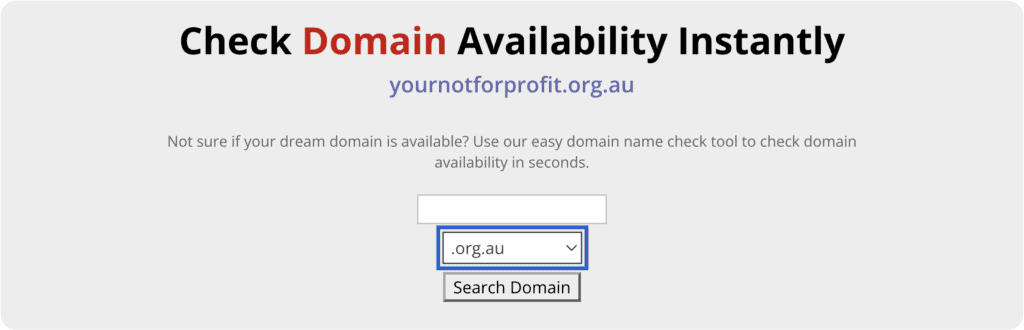
Start by checking whether your preferred .org.au name is available, then apply for community hosting or contact our Australian team if you are not sure which plan fits. We will help you work it out.