Your domain name is the address customers use to find you, and the foundation your business email sits on. It is also the one part of your online presence with an expiry date attached.
Let it expire and the consequences arrive fast. Your website stops loading, your email stops arriving, and after a short window the name can be picked up by somebody else entirely. Recovering it then ranges from expensive to impossible.
The good news is that renewing takes a few minutes. This guide covers when to renew, exactly what happens if you miss the date, and how to make sure you never have to think about it again.
What is domain renewal?
Domain renewal is the payment that extends your registration for another term, keeping the name assigned to you.
This is where a lot of confusion starts. You do not buy a domain name outright. You licence it for a set period, and that licence has to be renewed to stay valid. Stop paying and the name returns to the pool for anyone else to register.
The term you choose is up to you. Most extensions can be renewed for one to ten years at a time, though .au names are capped at five. Longer terms mean fewer deadlines to miss.
When should you renew your domain name?
Renew early, not on the deadline. Waiting until the expiry date is the single most common reason people lose a domain.
For .au domains, auDA allows renewal up to 90 days before the licence expires, and your registrar will normally email a reminder as that window opens. Renewing early does not waste money either. The additional term is added to your existing expiry date, not to the date you paid.
There is a second reason not to leave it late. Some registrars apply their own cut-off ahead of the registry deadline, in some cases stopping renewals up to 12 days before expiry for .au names. A renewal attempted on the final afternoon may simply not go through.
| Extension | Renew up to | Maximum term | Notes |
| .com.au, .net.au, .org.au | 90 days before expiry | 5 years | Eligibility must still be met at renewal |
| .au (direct) | 90 days before expiry | 5 years | Same auDA licensing rules apply |
| .com, .net, .org | Any time before expiry | 10 years total | Renewal grace period usually applies |
| Other gTLDs (.io, .co, .shop) | Any time before expiry | Usually 10 years | Rules vary by registry, check yours |
How to renew your domain name
Renewing is a self-service task in your provider’s control panel. With Domain Central, the process runs like this:
- Log in to your Client Area at clients.domaincentral.com.au.
- Open Domains and find the name you want to renew.
- Check the expiry date and select your renewal term.
- Pay the invoice, and switch on auto renewal while you are there.
Your new expiry date updates shortly after payment clears. If you manage several names, renew them all to the same date so you only have one deadline to track each year.
What auto renewal actually does: Auto renewal generates your renewal invoice automatically, one month before the domain is due. It is a reminder system, not a payment system. The invoice still has to be paid, and it will only pay itself if you have a valid card saved as your payment method. If your card has expired, or your account is set to a manual payment method such as bank transfer, you need to pay that invoice yourself or update your card before the due date. Auto renewal switched on with an expired card is the most common way a domain slips through the cracks.
What happens if your domain expires?
That depends heavily on your extension, and the difference between .au and .com is bigger than most people expect.
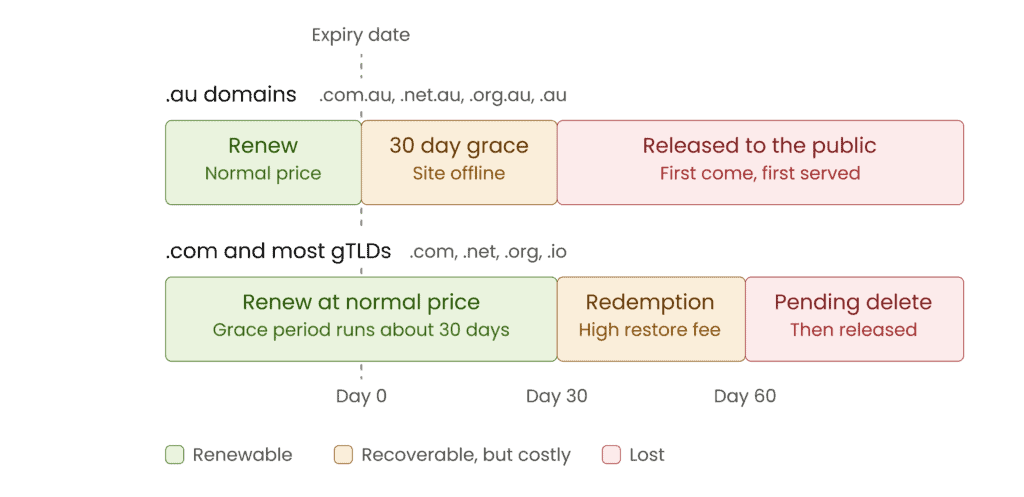
An expired .au domain gets a 30 calendar day grace period. During that time you can still renew it through your existing provider or a new one, but the name stops working immediately. Your website and email services will not function during the grace period, and some providers charge a fee to restore a domain during it. If the 30 days pass without renewal, the name is removed from the registry and becomes available to the public on a first come, first serve basis.
Generic extensions such as .com run on a longer but more expensive timeline. After expiry there is typically a renewal grace period of around 30 days at the normal price, followed by a 30 day redemption period where recovery requires a restore fee that commonly runs from AUD 100 upwards on top of the renewal cost. After that comes a five day pending delete stage, where nothing can be done, and then the name drops.
| Stage | .au domains | .com and most gTLDs |
| Immediately after expiry | Site and email go offline | Site and email usually go offline |
| Grace period | 30 days, renewable, restore fee possible | Around 30 days, renewable at normal price |
| Redemption period | None | Around 30 days, high restore fee applies |
| Pending delete | Not applicable | Around 5 days, no recovery possible |
| After that | Released to the public | Released to the public |
The practical takeaway is the same for both. Once a name is released, getting it back is a matter of luck and negotiation rather than process. Valuable expired domains are often registered within seconds by automated drop catching services.
Renewal is also an eligibility checkpoint for .au domains
Paying the invoice is not always enough for an Australian domain. To renew a .au name, you must still meet auDA’s eligibility rules, which for most businesses means holding a current ABN or ACN that matches the registrant details.
If your ABN has been cancelled since you registered, your licence can be cancelled even though you paid. This catches out sole traders and businesses that have restructured, changed entities or wound up an old ABN.
Renewal time is the natural moment to check three things: that your ABN is still active, that the registrant name on the domain matches the entity holding it, and that your contact email still works. Reminder emails sent to an address nobody reads are the most common reason a renewal is missed.
Do not forget what else expires alongside your domain
Renewing your domain renews the domain only. The services attached to it run on their own billing cycles, and any one of them lapsing will take part of your online presence down.
| Service | What happens if it lapses | Typical term |
| Domain name | Website and email both stop working | 1 to 5 years (.au), up to 10 (gTLD) |
| Web hosting | Website goes offline, files may be deleted | Monthly or yearly |
| SSL certificate | Browsers show a security warning to visitors | Now under 200 days |
| Business email | Mailboxes stop sending and receiving | Monthly or yearly |
SSL is worth flagging specifically. Certificate lifetimes are shrinking industry wide, dropping to a maximum of 200 days from March 2026 and shorter again in the years after, which means far more frequent renewals than most site owners are used to.
Watch out for fake renewal notices
Expiry deadlines create urgency, and scammers know it. Fake renewal invoices are a long running problem in Australia, often arriving from providers you have never used, quoting a real domain name and a plausible price.
Before paying anything, check three things. Confirm the sender is actually your registrar, log in to your Client Area directly rather than through a link in the email, and compare the expiry date shown there with the one in the notice. A genuine invoice will match your account exactly.
How to never miss a renewal again
- Turn on auto renewal. It raises your renewal invoice a month ahead, so the deadline never sneaks up on you.
- Save a valid card as your payment method. This is the step that turns auto renewal into genuinely hands-off renewal. Without it, the invoice is generated but still waits for you.
- Check your card expiry dates. A card that lapses between renewals leaves an unpaid invoice sitting in your account.
- Use a monitored email address. Ideally one at your own domain, checked by more than one person.
- Register for multiple years. Fewer deadlines means fewer chances to miss one.
- Consolidate your services. Domains, hosting and email with one provider means one login and one renewal date.
Frequently asked questions
Can I renew a domain that has already expired? Usually yes, if you act quickly. A .au name can be renewed during the 30 day grace period after expiry, though your site and email will be down in the meantime. A .com domain can be renewed during its grace period at the normal price, or restored during redemption for a significant extra fee.
Does renewing my domain restore my website? Renewing the domain brings the name back into service, but your website also needs active hosting and your email needs an active mailbox. If those lapsed at the same time, they need renewing too.
Can I transfer a domain instead of renewing it? Yes, and transferring to a new provider generally adds a year to the registration. Transfers take time to complete though, so start well before the expiry date rather than using a transfer as a last minute rescue.
How much does domain renewal cost? It varies by extension, and renewal pricing is not always the same as the promotional price paid at registration. Check the renewal price for your specific extension before committing to a long term.
Does auto renewal mean my domain renews itself? Not on its own. Auto renewal generates your renewal invoice automatically a month before the due date. Whether it then pays itself depends on your payment method. With a valid card saved, the renewal completes without you doing anything. On a manual payment method, or with an expired card, the invoice sits waiting until you pay it. Check both settings when you switch auto renewal on.
Will I get a reminder before my domain expires? Your registrar is required to send reminders, and Domain Central sends them ahead of every expiry date. They are only useful if they reach you, so keep your contact email current and check your spam folder around renewal time.
Keep your domain, keep your business online
Domain renewal is a small, routine task with an outsized downside if it is missed. A few minutes in your Client Area, auto renewal switched on, a valid card saved against it, and contact details that actually work will protect you from almost every scenario in this guide.
Not sure when your domains expire, or managing names spread across several providers? Log in to your Client Area to check your dates, or get in touch with our Australian based team and we will help you consolidate everything into one place.