Comparing three sign-up prices and taking the cheapest is how most people choose a host. It is also why the bill a year later comes as a surprise.
The sign-up price is the one number a host prints in large type. The renewal price, the add-ons and the server location decide what you actually pay and how fast your site loads.
What “best” actually means for a small business site
For a typical small business website, best means the site loads quickly for Australian visitors, stays online, is backed up, and costs roughly the same in year three as in year one.
A five page brochure site for a plumber, a physio clinic or a consultancy does not need enterprise infrastructure. It needs an Australian server, an SSL certificate, automatic backups, and someone who answers the phone during Australian business hours when something breaks on a Friday afternoon.
Match the plan to the site you actually have.
| Type of site | Realistic monthly traffic | Hosting tier that fits |
| Brochure or landing page | Under 5,000 visits | Entry shared or WordPress starter |
| Content and lead generation site | 5,000 to 25,000 visits | Managed WordPress, mid tier |
| Small online shop | 5,000 to 25,000 visits with checkout | Managed WordPress, higher memory and CPU |
| Booking or member portal | Variable, database heavy | Higher tier WordPress or VPS |
| Not-for-profit or community site | Low and predictable | Community hosting |
If you are still deciding between shared, VPS and dedicated, Web Hosting 101 breaks down the differences in plain English.
Why the renewal price matters more than the sign-up price
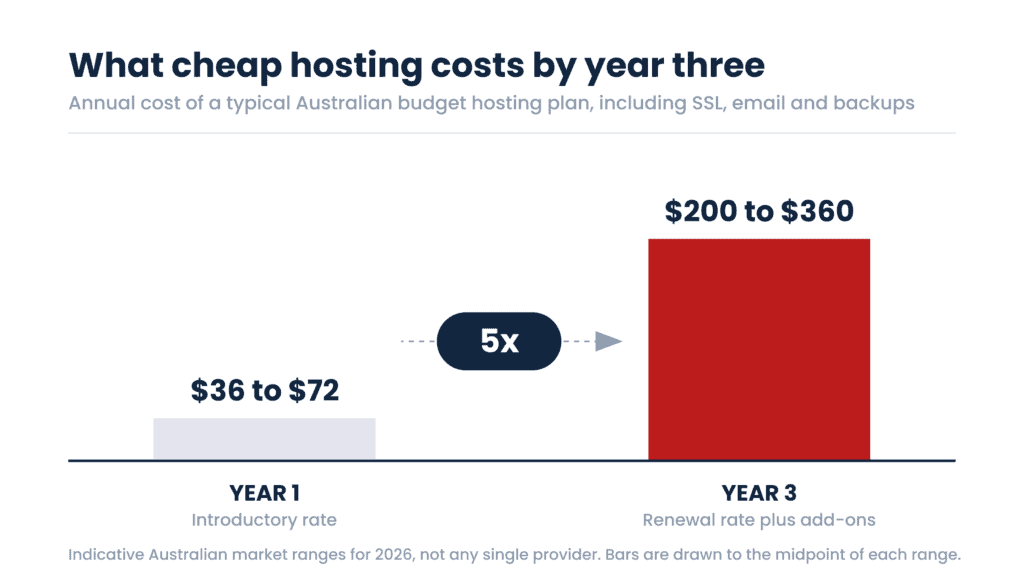
The sign-up price applies once. The renewal price applies every year after that, and across the market it is commonly two to four times higher.
A plan advertised at around $3 per month usually requires a two, three or four year prepayment. When that term ends, the same plan renews somewhere between $10 and $20 per month for an identical service.
Then come the extras. An SSL certificate that was free in year one can be billed at close to $100 per year afterwards. Email mailboxes, daily backups and malware scanning are frequently separate line items. A plan that looked like $48 for the first year can land near $240 in the second.
| Cost line | Typical budget host, year 1 | Typical budget host, year 2 |
| Hosting plan | $36 to $72 | $120 to $240 |
| SSL certificate | Free for 12 months | $0 to $100 |
| Email mailboxes | Sometimes bundled | $30 to $60 |
| Daily backups | Trial or bundled | $50 to $60 |
| Realistic annual total | $36 to $72 | $200 to $360 |
Figures are indicative Australian market ranges for 2026, not any single provider.
Before you enter your card details, find the renewal rate in the terms, work out the three year total, and compare providers on that number instead. A plan that costs more upfront and stays flat is usually cheaper by year two.
Does the server really need to be in Australia?
For a business selling to Australian customers, yes. The reason is distance.
A request from Brisbane to a server in Sydney or Melbourne comes back faster than the same request to Singapore, and much faster than a round trip to the United States. That gap repeats for every image, script and stylesheet on the page. Slow pages lose visitors before the content appears, and page experience feeds into how your site performs in search.
Local hosting also affects three things that have nothing to do with speed:
Billing. An Australian provider bills in Australian dollars. Overseas plans priced in US dollars move with the exchange rate, so your hosting bill changes without the provider changing anything.
Support hours. If your host’s support team is asleep when your site goes down, you wait. For a business that takes bookings or orders online, an eight hour delay is a real cost.
Data location. You should be able to name the country your customer data sits in, particularly if you store personal information or customer records.
The nine checks to run before you buy
Open the pricing page of any host you are considering and work through this list. If you cannot find an answer within a minute, treat that as the answer.
| Check | What you want to see | Why it matters |
| Renewal price | Stated openly, close to the intro rate | This is your actual long term cost |
| Server location | Australian data centre | Load speed for local visitors |
| SSL certificate | Included, and included at renewal | Browsers warn visitors away without HTTPS |
| Backups | Automatic, with self-service restore | Your recovery plan when something breaks |
| Support | Australian hours, phone and ticket | Downtime on a Friday afternoon |
| Upgrade path | Change plan without migrating | Growth should not mean rebuilding |
| Staging site | Included | Test changes before they hit customers |
| Money-back period | Clearly stated | Lets you leave if it is not right |
| Priced separately and clearly | See the next section |
Email is a separate decision, and worth making deliberately
Bundled hosting mailboxes are usually the weakest part of a cheap plan. You get small quotas, poor mobile apps, and a sending reputation shared with every other site on the server, which is how legitimate invoices end up in spam folders.
Keep the two decisions apart. Host the website where it performs, and put your business email on a service built for email. Titan Mail gives every staff member a mailbox on your own domain with calendars, contacts, mobile apps and one-click import from an existing account. For teams already working in Word, Excel and Teams, Microsoft 365 is the better fit.
Whichever you choose, set up an SPF record so your quotes and invoices reach the inbox. Email Hosting 101 covers how the free and paid options compare.
What Domain Central charges
For transparency, here are our own plans at the time of writing. Prices are in Australian dollars.
| Plan | Monthly | Yearly | Storage | Memory | Suits |
| WordPress Starter | $15 | $180 | 10GB | 1GB | Brochure sites, first business site |
| WordPress Business | $25 | $300 | 15GB | 2GB | Content sites, small teams |
| WordPress Deluxe | $45 | $528 | 20GB | 4GB | Busy sites, agencies, shops |
Every plan includes a free Let’s Encrypt SSL certificate, automatic backups, one-click WordPress updates, Imunify360 security and a staging site. Annual plans include a free .au domain for the first year, subject to eligibility. There is a 30 day money-back guarantee, and you can move up a plan as traffic grows without rebuilding the site.
See WordPress Hosting for the full specification, Plesk Hosting if you are not using WordPress, or Community Hosting, which is free for eligible not-for-profits.
Switching hosts without taking your site offline
Changing provider carries less risk than most people expect, as long as you do it in this order.
Set the new hosting up first and copy the site across while the old one is still live. Test it on a temporary address until every page and form works. Only then repoint the DNS, and leave the old plan running for a week afterwards as a safety net. Move your domain separately using a domain transfer so the registration and the hosting are not in motion at the same time.
Most providers, including us, will do the migration for you. Ask before you pay for anything.
Frequently asked questions
How much should a small business spend on web hosting in Australia? Between $15 and $50 per month covers most small business sites on managed WordPress hosting with SSL, backups and staging included. Plans under $5 per month usually reflect an introductory rate that will rise sharply at renewal.
Is Australian hosting worth paying more for? If your customers are in Australia, yes. You get faster load times for local visitors, billing in Australian dollars that does not move with the exchange rate, and support in your own time zone.
Do I need a .com.au domain? You need one that customers trust and can remember. A .com.au or .au domain signals an Australian business and requires a verified ABN or ACN. Domain Names 101 covers the eligibility rules and .au Direct explains the shorter namespace.
What happens if my site outgrows the plan? On a well-designed plan you move up a tier and keep the same site. Ask before signing whether upgrading requires a migration, because on some hosts it does.
Is a free SSL certificate good enough? For most small business sites, yes. A free Let’s Encrypt certificate encrypts traffic exactly like a paid one. Paid certificates add organisation validation and warranty cover, which matters more for shops handling payments. SSL Certificates 101 explains the difference.
If you want a second opinion on which plan fits your site, get in touch and we will tell you straight, including when a smaller plan is the right answer.