Forbes Advisor’s list of the best domain registrars for Australians recommends seven companies. Four of them can’t register a .com.au. Most “best registrar” rankings work the same way. They sort by first-year price and leave the details that matter to an Australian business for you to find out a year later.
For a small business, the best registrar keeps the domain in your name, renews it at a price you can predict, keeps strangers out of the account and lets you leave without a fight. Here is how to check each of those before you pay.
What “best” means for a small business domain
Your domain does two jobs. It is the address of your website, and your business email runs on it. If the registration lapses, your site and your inbox can both go dark on the same day.
The best registrar for you is the one least likely to cause that day. That comes down to four things: a renewal price you can predict, an account only you control, registration details in your business’s name, and a clean exit if you want to move.
Why the first-year price tells you almost nothing
Every accredited registrar pays the .au registry the same wholesale fee for each domain: $8.64 plus GST per year, rising to $9.50 plus GST on 1 October 2026, according to auDA. A registrar advertising a .com.au for one cent sells the first year about $9.50 below cost. It recovers that money at renewal, for as long as you stay.
That is legal and common. It also means the number worth comparing is the five-year total.
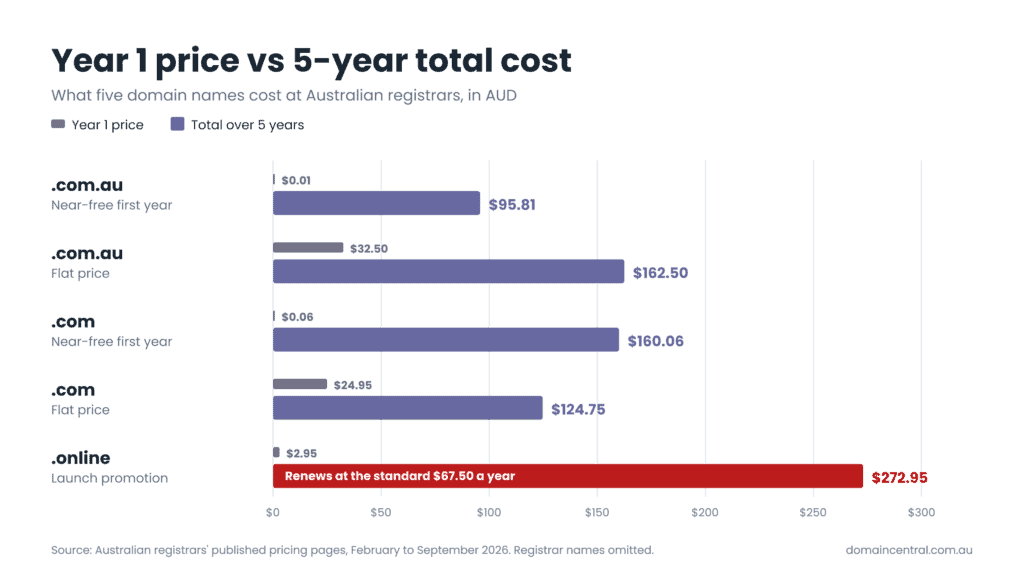
| Domain and pricing model | Year 1 | Years 2 to 5 (per year) | 5-year total |
| .com.au, near-free first year | $0.01 | $23.95 | $95.81 |
| .com.au, flat price | $32.50 | $32.50 | $162.50 |
| .com, near-free first year | $0.06 | $40.00 | $160.06 |
| .com, flat price | $24.95 | $24.95 | $124.75 |
| .online, launch promotion | $2.95 | $67.50 | $272.95 |
Prices taken from Australian registrars’ own pricing pages between February and September 2026, in AUD. We left the names out because promotional prices change every few weeks.
The .com with the six-cent first year costs $35 more over five years than the .com with a flat price. The $2.95 .online deal ends up as the most expensive domain in the table, because its standard price is $67.50 a year. Flat pricing doesn’t guarantee the lowest total either, since the flat .com.au is the dearest .com.au here. Work out the five-year figure for the exact domain you want and compare that.
The .au price rise on 1 October 2026
In August 2026 auDA announced that the wholesale price of every .au domain, including .com.au, .net.au and .au direct, goes from $8.64 to $9.50 plus GST on 1 October 2026. auDA says the change covers CPI and funds a new rebate for registrars that meet quality and security standards.
Registrars set their own retail prices, so the increase will reach customers at different times. If your renewal is due in the next few months, ask whether renewing now for several years locks in the current price. A .au domain can be registered or renewed for one to five years at a time.
Ten checks to run before you register
Work through this list on the pricing and help pages of any registrar you are considering. If an answer takes more than a minute to find, count it as a no.
| Check | What you want to see | Red flag |
| Accreditation | auDA accredited registrar, or a reseller on the auDA provider list | Not listed anywhere |
| Renewal price | Published next to the sign-up price | Only the first-year price is shown |
| Registrant | Your business name and ABN | Your web designer or an agency |
| Transfer out | Auth code sent on request, at no charge | A “release” or admin fee, or days of silence |
| Account security | Two-factor login offered on the account | Password only, with no second factor available |
| Auto-renew | On by default, with reminders | Reminders only after expiry |
| DNS management | Included, with full access to MX, SPF, DKIM and DMARC records | DNS locked or charged extra |
| Checkout | Add-ons unticked by default | Extras pre-selected in the cart |
| .au privacy | Not offered, because auDA doesn’t allow it | A paid “privacy” add-on on a .com.au |
| Billing | AUD, GST shown | USD, so the price moves with the exchange rate |
Two rows work differently on .au than on .com. Transferring a .au domain is free, because auDA rules stop your current registrar from charging a transfer fee, and you can recover your own auth code through auDA’s password tool. A .com transfer usually costs a year of renewal instead.
.au domains also have no standard registrar lock, so your account login is the lock. That makes two-factor authentication the security setting that matters. Switch it on wherever your registrar offers it, even where nobody makes you.
Without full DNS access you can’t add the records that prove your email is genuine, and more of it lands in spam. Our guides to SPF records and DMARC show which records you need.
Make sure the domain is registered to you
Some of the costliest domain problems have nothing to do with price. A web designer registers a client’s .com.au in their own account, then moves on. Years later the business needs a transfer code or a DNS change, and nobody can reach the person holding the login.
For a .com.au, the registrant is the entity whose ABN or ACN was used to prove eligibility. Search your domain in the free .au WHOIS tool and check the registrant is your business. While you are there, look at the contact email. Use a shared address that more than one person can open, and ideally one on a different domain. If the domain ever lapses, mail to that domain stops too, and so do the reminders you needed.
auDA doesn’t allow privacy or proxy services on .au domains. Its WHOIS policy already keeps street addresses and phone numbers off the public record, so a registrar charging for “privacy” on a .com.au is selling you nothing.
Because registrant names and emails are public, fake renewal invoices and “compliance” notices are common. Pay only inside your registrar’s own account. Our guide to domain compliance notices shows how to spot the fakes.
One provider for domain, website and email, or keep them separate?
Both work. The trade-off looks like this:
| One provider | Separate providers | |
| Bills and renewals | One account, one renewal list | Several accounts and dates to track |
| When email stops working | One support team can see DNS, hosting and mail together | Each provider may point to another |
| If a login is stolen | Everything sits in one account, so two-factor login matters more | Damage stays within one service |
| Moving later | Move one service or all of them | Already separated |
If you keep everything together, turn on two-factor authentication and add a second trusted admin. If you split them, keep the domain at your registrar and point its DNS wherever the website and email live. DNS 101 explains how that works.
At Domain Central, your domain, WordPress hosting and Titan Mail sit in one account. Titan Personal, Business and Ultra plans on a one or two year term include the first year of a new .com.au, .net.au or .au domain free, if you meet the eligibility rules.
Moving a domain you already have
If your current registrar fails the checks above, you can move. Unlock the domain, request the transfer code from your current registrar and start the transfer at the new one. Confirm the registrant details first, because a transfer is a bad moment to discover the domain belongs to another person.
Ask whether the transfer adds a year to the registration and whether either side charges a fee. Don’t start a transfer in the last two weeks before expiry, or on the same day you move your hosting. Our domain transfer page walks through each step.
Frequently asked questions
What is the best domain registrar in Australia for a small business? No single registrar suits everyone. Pick an auDA accredited registrar or listed reseller that publishes renewal prices, registers the domain in your business’s name, offers two-factor login and lets you transfer out for free. Then compare five-year costs.
How much should a .com.au cost? Published renewal prices at Australian registrars mostly sat between about $23 and $33 a year in 2026. A first-year price far below the wholesale cost of about $9.50 including GST (about $10.45 from 1 October 2026) is a promotion that renewal will pay for.
Do I need domain privacy for a .com.au? No, and you can’t buy it. auDA doesn’t permit privacy services on .au domains, and the .au WHOIS doesn’t publish your street address or phone number.
Can I register a .com.au without an ABN? A .com.au or .net.au needs an ABN, ACN or Australian trademark. .au direct is open to anyone with a verifiable Australian presence, including individuals. Domain Names 101 covers the rules for each extension.
What happens if my domain expires? Your website and email can stop working, and after the grace period someone else can register the name. Our domain renewal guide explains the timeline and how to avoid it.
Ready to check a name? Search for it on our domain registration page, or contact us if you want a second opinion on whether moving your current domain is worth it.